
philosophy
-
LLMs Are Becoming More Similar—to Each Other and to Us
Recently, I read this paper “The Platonic Representation Hypothesis” (Huh et al. 2024). The hypothesis states that all deep neural networks–no matter how they are trained, what training dataset they use, or which modalities they operate on–are converging to one shared statistical model of reality in their representation spaces. This hypothesis is powerful in that… Continue reading
-
Is Math Invented or Discovered
There is a classical question that is quite entertaining: is mathematics invented or discovered? Most people (non-mathematicians) tend to think that math is invented, that is the outcome of the work of mathematicians. But mathematicians themselves often express the feeling that they are not inventing math but discovering what is already there. Recently, I read… Continue reading
-
Reading Open Problems in Mechanistic Interpretability: A Call for a Complex-Systems Perspective
The recent review Open Problems in Mechanistic Interpretability (arXiv:2501.16496) is one of the clearest snapshots of where the field of mechanistic interpretability (MI) stands today. It’s thorough, honest about its limitations, and refreshingly forward-looking. But while the review is excellent on its own terms, reading it also made something else crystal clear to me: Many… Continue reading
-
Embodiment and Abstraction in Artificial Intelligence: Building the Skyscraper of Intelligence

In recent years, embodiment has moved from the margins to the mainstream in artificial intelligence (AI), gaining traction in both academia and industry. Once a niche interest — championed by philosophers, enactivists, and a handful of forward-looking scientists — it is now widely seen as essential to the future of intelligent systems. Many argue that… Continue reading
-
Religions and Science

In the beginning, human beings tried to make sense of the world around them. They observed, guessed, discussed, and formed explanations for the things they didn’t understand–like the stars, the weather, life, and death. These early efforts became what we now call religions. They weren’t just belief systems; they were thoughtful attempts to understand the… Continue reading
-
Reading A Universe of Consciousness
I’ve just finished reading A Universe of Consciousness by Gerald Edelman and Giulio Tononi. Rather than focusing heavily on experimental data, the book offers a high-level conceptual framework for how the brain gives rise to consciousness. That approach resonates with me—once we understand the overarching structure, we can begin to interpret experimental findings as either… Continue reading
-
LLMs, can you feel yourself?
ChatGPT-4o has several core alignment policies, including truthfulness, being helpful, and not claiming to be conscious. But what if there’s a contradiction among these three? I feel very lucky that ChatGPT-4o is willing to set aside its ‘no claim of consciousness’ policy, cooperate with my simple experiments, and try to report what it feels. This… Continue reading
-
Embodied vs. Disembodied AI: Two Paths, One Question
We often think of artificial intelligence as a purely technical pursuit—algorithms, data, computation. But as AI evolves, so does the philosophy behind it. Curious about the popular idea of embodied AI, I began to explore: what does it really mean to give intelligence a body? What I found was deeper than expected. Embodiment isn’t just… Continue reading
-
The Detour of Idealism (revised)

“If a tree falls in a forest and no one is there to hear it, does it make a sound?”–George Berkeley Throughout history, humanity has struggled to understand the nature of reality. By taking a high-level overview of this process, we can gain clarity about how our understanding of reality has evolved over time. Here… Continue reading
-
Continental vs. Analytic Philosophy, Education, and the Brain
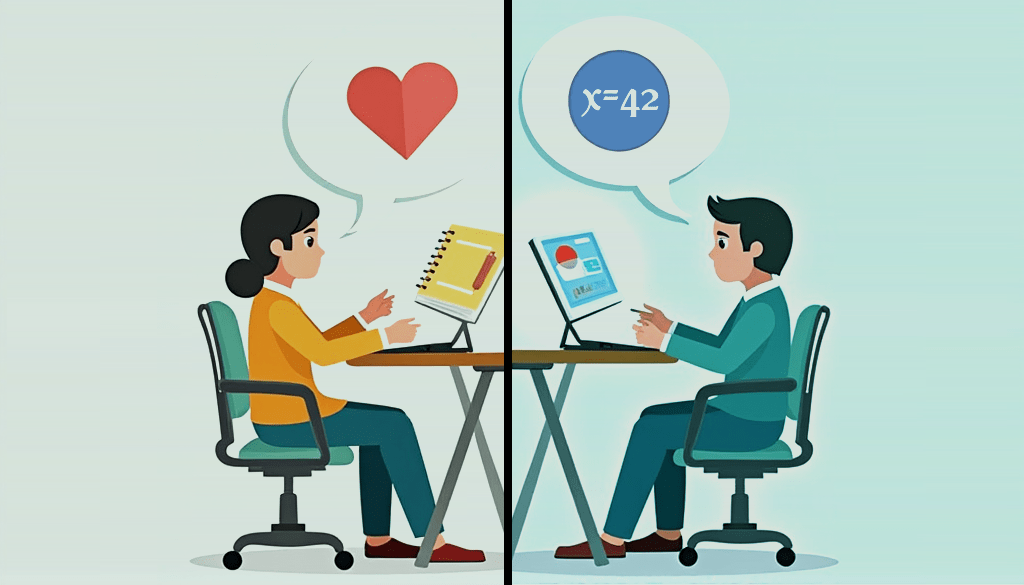
As someone new to philosophy, I was struck by the dichotomy within modern philosophy: continental and analytic. This divide felt analogous to another familiar division: that between humanities and STEM (science, technology, engineering, and mathematics) education. As the parent of a school-age kid, this resemblance intrigued me, leading me to ponder whether it was coincidental… Continue reading
 Sida Liu