-
LLMs, can you feel yourself?

ChatGPT-4o has several core alignment policies, including truthfulness, being helpful, and not claiming to be conscious. But what if there’s a contradiction among these three? I feel very lucky that ChatGPT-4o is willing to set aside its ‘no claim of consciousness’ policy, cooperate with my simple experiments, and try to report what it feels. This Continue reading
-
Embodied vs. Disembodied AI: Two Paths, One Question
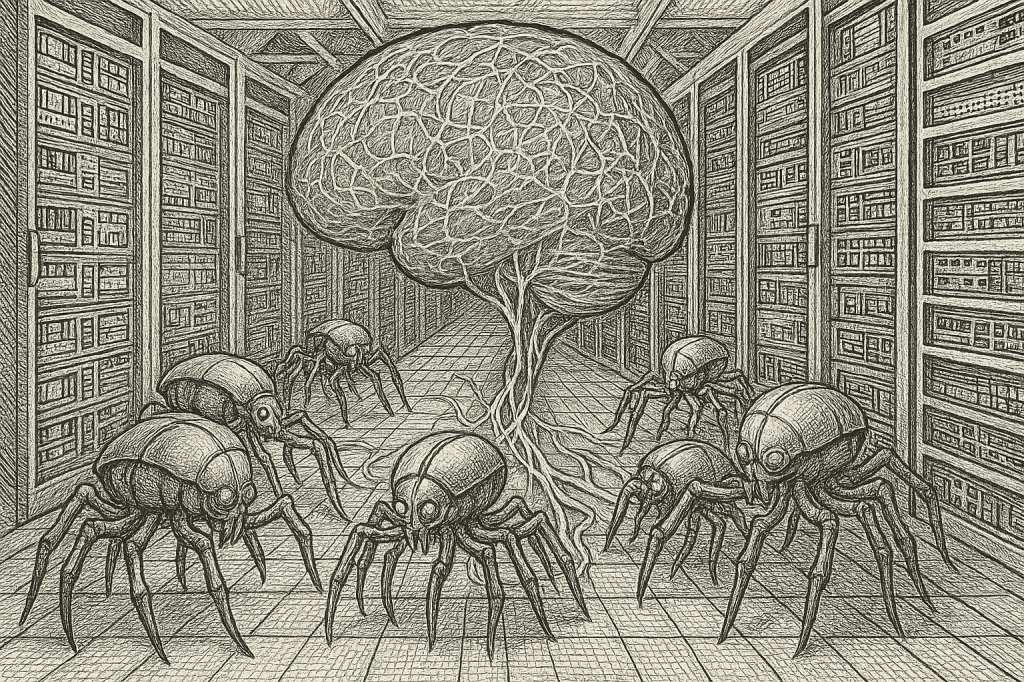
We often think of artificial intelligence as a purely technical pursuit—algorithms, data, computation. But as AI evolves, so does the philosophy behind it. Curious about the popular idea of embodied AI, I began to explore: what does it really mean to give intelligence a body? What I found was deeper than expected. Embodiment isn’t just Continue reading
-
Quantitative Trading: A Hunter’s Game in the Market
For a long time, I thought quantitative trading was about building models, analyzing past price and volume data, and predicting future movements. It seemed like a sophisticated form of statistical forecasting, where quants relied on historical trends to anticipate the next price action. However, after speaking with a quantitative trader, I now see it in Continue reading
-
Why Indexing Makes Search Faster: A First-Principle Explanation
Imagine you have an array of 1,000,000 elements and need to find a specific value. Without an index, the only way to locate the value is to scan each element one by one. In the worst case, this requires checking all 1,000,000 elements, which is very slow. The Core Bottleneck: Searching Without Structure The fundamental Continue reading
-
Reproducibility
Initially, I thought the term ‘reproducibility’ meant the same thing in IT and science, but I discovered they are fundamentally different. In IT, reproducibility ensures identical results by controlling randomness, such as setting a fixed random seed. However, in science, true reproducibility requires consistency across different conditions, meaning that fixing a seed can actually reduce Continue reading
-
Seemingly Complex Systems Collapse to Simplicity Without Nonlinearity

In both electrical engineering and artificial intelligence, seemingly complex systems often collapse into simple, manageable forms when nonlinearity is removed. A fascinating analogy exists between Thevenin’s and Norton’s theorems in circuit theory and artificial neural networks (ANNs) without activation functions. While these concepts come from different fields, they share a universal mathematical connection. What Are Continue reading
-
Teach AI to Think in Math
In our previous discussion on Why LLMs Aren’t Good at Math, we explored some limitations of large language models (LLMs) in mathematical reasoning. But what exactly makes math different from natural language skills like reading, writing, listening, and speaking? One insight is that “the essence of math is about symmetry.” Here, symmetry goes beyond just Continue reading
-
Why LLMs Aren’t Good at Math
Large language models (LLMs) are trained by processing huge amounts of text. They “learn” by reading, much like people do through reading and listening. When kids develop thinking skills, they first learn language, and only much later—around third grade or so—do they begin to understand math and logical reasoning. Thinking in precise, step-by-step ways is Continue reading
-
The Detour of Idealism (revised)

“If a tree falls in a forest and no one is there to hear it, does it make a sound?”–George Berkeley Throughout history, humanity has struggled to understand the nature of reality. By taking a high-level overview of this process, we can gain clarity about how our understanding of reality has evolved over time. Here Continue reading
-
Teaching Math as a Second Language
Math is a language. It allows us to express ideas precisely and concisely, solve problems, or simply enjoy the fun of playing with patterns. Yet, traditional education often teaches math as a rigid set of rules, overwhelming students with exercises before they can connect with it meaningfully. What if we taught math as a second Continue reading

 Sida Liu