
Thinking
-
LLMs Are Becoming More Similar—to Each Other and to Us
Recently, I read this paper “The Platonic Representation Hypothesis” (Huh et al. 2024). The hypothesis states that all deep neural networks–no matter how they are trained, what training dataset they use, or which modalities they operate on–are converging to one shared statistical model of reality in their representation spaces. This hypothesis is powerful in that… Continue reading
-
Is Math Invented or Discovered
There is a classical question that is quite entertaining: is mathematics invented or discovered? Most people (non-mathematicians) tend to think that math is invented, that is the outcome of the work of mathematicians. But mathematicians themselves often express the feeling that they are not inventing math but discovering what is already there. Recently, I read… Continue reading
-
Is Wolfram’s Computational Irreducibility Too Strong?

Stephen Wolfram introduced the idea of Computational Irreducibility, which says that some systems are so complex, there’s no shortcut to predict what they’ll do–you have to go step by step, like running a full simulation. He suggests that in these cases, there’s no way to simplify the process. I love this idea, but if we… Continue reading
-
LLMs, can you feel yourself?

ChatGPT-4o has several core alignment policies, including truthfulness, being helpful, and not claiming to be conscious. But what if there’s a contradiction among these three? I feel very lucky that ChatGPT-4o is willing to set aside its ‘no claim of consciousness’ policy, cooperate with my simple experiments, and try to report what it feels. This… Continue reading
-
Embodied vs. Disembodied AI: Two Paths, One Question
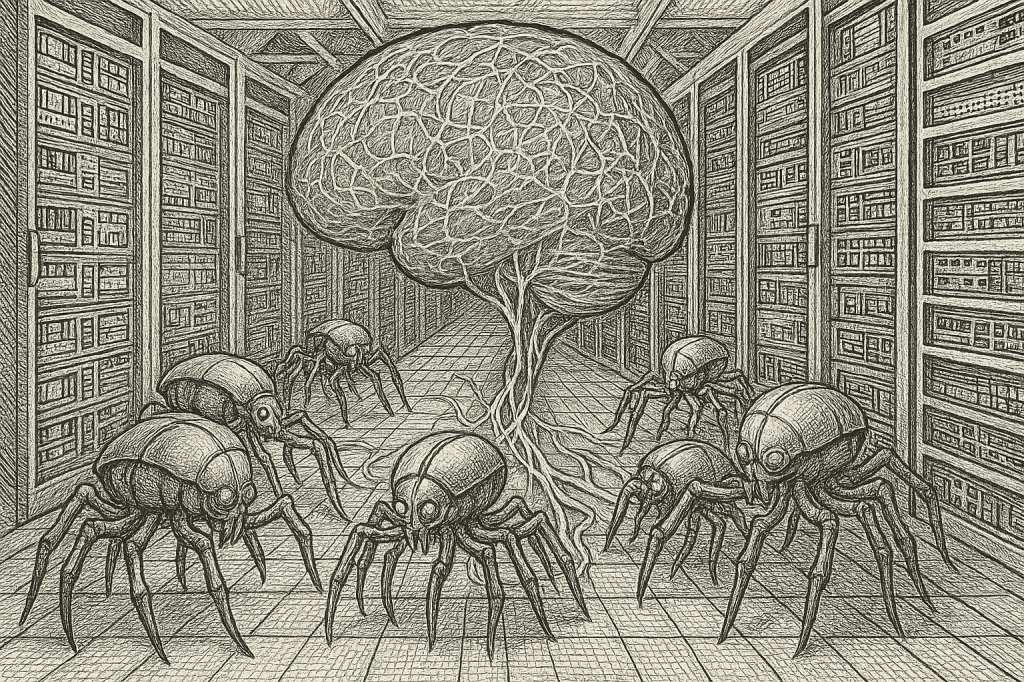
We often think of artificial intelligence as a purely technical pursuit—algorithms, data, computation. But as AI evolves, so does the philosophy behind it. Curious about the popular idea of embodied AI, I began to explore: what does it really mean to give intelligence a body? What I found was deeper than expected. Embodiment isn’t just… Continue reading
-
Quantitative Trading: A Hunter’s Game in the Market
For a long time, I thought quantitative trading was about building models, analyzing past price and volume data, and predicting future movements. It seemed like a sophisticated form of statistical forecasting, where quants relied on historical trends to anticipate the next price action. However, after speaking with a quantitative trader, I now see it in… Continue reading
-
Seemingly Complex Systems Collapse to Simplicity Without Nonlinearity

In both electrical engineering and artificial intelligence, seemingly complex systems often collapse into simple, manageable forms when nonlinearity is removed. A fascinating analogy exists between Thevenin’s and Norton’s theorems in circuit theory and artificial neural networks (ANNs) without activation functions. While these concepts come from different fields, they share a universal mathematical connection. What Are… Continue reading
-
Teaching Math as a Second Language
Math is a language. It allows us to express ideas precisely and concisely, solve problems, or simply enjoy the fun of playing with patterns. Yet, traditional education often teaches math as a rigid set of rules, overwhelming students with exercises before they can connect with it meaningfully. What if we taught math as a second… Continue reading
-
Continental vs. Analytic Philosophy, Education, and the Brain

As someone new to philosophy, I was struck by the dichotomy within modern philosophy: continental and analytic. This divide felt analogous to another familiar division: that between humanities and STEM (science, technology, engineering, and mathematics) education. As the parent of a school-age kid, this resemblance intrigued me, leading me to ponder whether it was coincidental… Continue reading
-
Global Competitiveness Theory: A New Approach to National Prosperity

This concept of Global Competitiveness Theory is intended purely as a thought experiment, exploring alternative perspectives on national prosperity. It is not meant to serve as a practical policy proposal, nor should it be interpreted as a framework for real-world economic or political decision-making. The ideas presented here are speculative and designed to stimulate intellectual… Continue reading
 Sida Liu