
Reading
-
LLMs Are Becoming More Similar—to Each Other and to Us
Recently, I read this paper “The Platonic Representation Hypothesis” (Huh et al. 2024). The hypothesis states that all deep neural networks–no matter how they are trained, what training dataset they use, or which modalities they operate on–are converging to one shared statistical model of reality in their representation spaces. This hypothesis is powerful in that… Continue reading
-
Is Math Invented or Discovered
There is a classical question that is quite entertaining: is mathematics invented or discovered? Most people (non-mathematicians) tend to think that math is invented, that is the outcome of the work of mathematicians. But mathematicians themselves often express the feeling that they are not inventing math but discovering what is already there. Recently, I read… Continue reading
-
Reading Open Problems in Mechanistic Interpretability: A Call for a Complex-Systems Perspective
The recent review Open Problems in Mechanistic Interpretability (arXiv:2501.16496) is one of the clearest snapshots of where the field of mechanistic interpretability (MI) stands today. It’s thorough, honest about its limitations, and refreshingly forward-looking. But while the review is excellent on its own terms, reading it also made something else crystal clear to me: Many… Continue reading
-
Reading A Universe of Consciousness
I’ve just finished reading A Universe of Consciousness by Gerald Edelman and Giulio Tononi. Rather than focusing heavily on experimental data, the book offers a high-level conceptual framework for how the brain gives rise to consciousness. That approach resonates with me—once we understand the overarching structure, we can begin to interpret experimental findings as either… Continue reading
-
A very short explanation of Wolfram’s Physics Project
Einstein believed that the apparent “randomness” in quantum mechanics was due to incomplete knowledge of underlying factors. His famous quote, “God does not play dice”, rejected the idea of true randomness. After Einstein, the mainstream Copenhagen interpretation prevailed, accepting the randomness and uncertainty as fundamental features. Wolfram’s Physics Project was launched in 2020, aiming to… Continue reading
-
My Notes on ‘On the Nature of Time’
Stephen Wolfram recently posted an essay ‘On the Nature of Time’: https://writings.stephenwolfram.com/2024/10/on-the-nature-of-time/ There are five sections: (1) The Computational View of Time, (2) The Role of the Observer, (3) Multiple Threads of Time, (4) Time in the Ruliad, and (5) So What in the End Is Time? In order to understand it more thoroughly, I… Continue reading
-
Reality+ by David Chalmers: A Chapter-by-Chapter Review
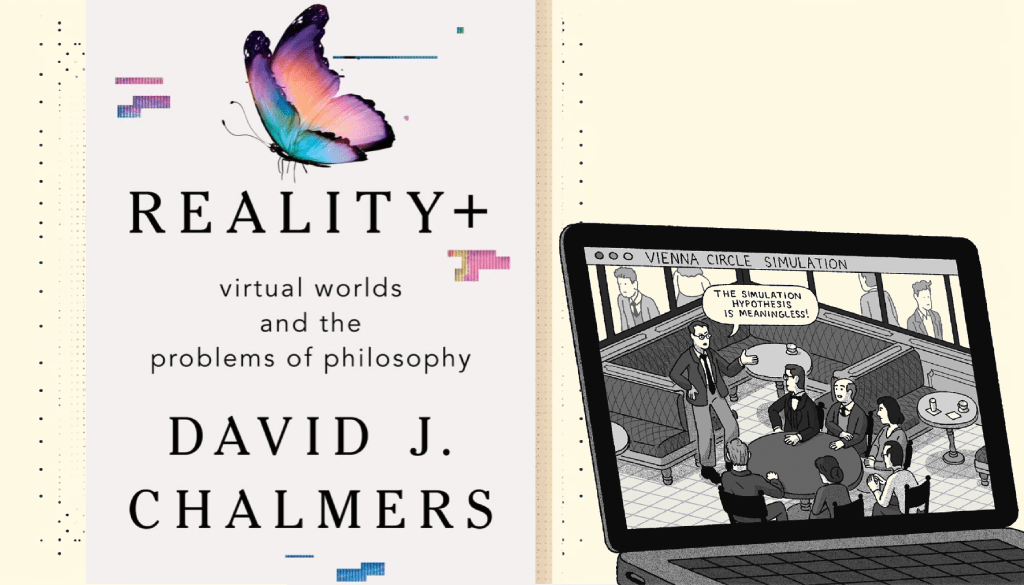
Introduction: When we think of philosophy, we might picture ancient philosophers disconnected from modern science. However, philosophy is the reconciliation of existing knowledge, and modern science and technology have brought us enormous amount of new knowledge, it’s now philosophers’ job to digest them. This is what the author, David Chalmers, calls ‘technophilosophy’: generating new questions… Continue reading
-
An Analogy between Literature and Mathematics? Reading ‘The Educated Imagination’

I heard about the book ‘The Educated Imagination’ in an interview with a math professor. She mentioned it because she likes the analogy that literature is just like math, both being languages of imagination. I like math but don’t understand literature, so I decided to explore this book to see if literature really is analogous… Continue reading
-
Some Basics, Reading ‘Game Theory, A Very Short Introduction’

I have begun learning about game theory and recently read Ken Binmore’s “Game Theory: A Very Short Introduction.” I would like to share some of my thoughts: Utility In game theory, there is a quantity called Utility. It represents the payoff for a player in a game. Von Neumann proposed a practical way to estimate… Continue reading
 Sida Liu