
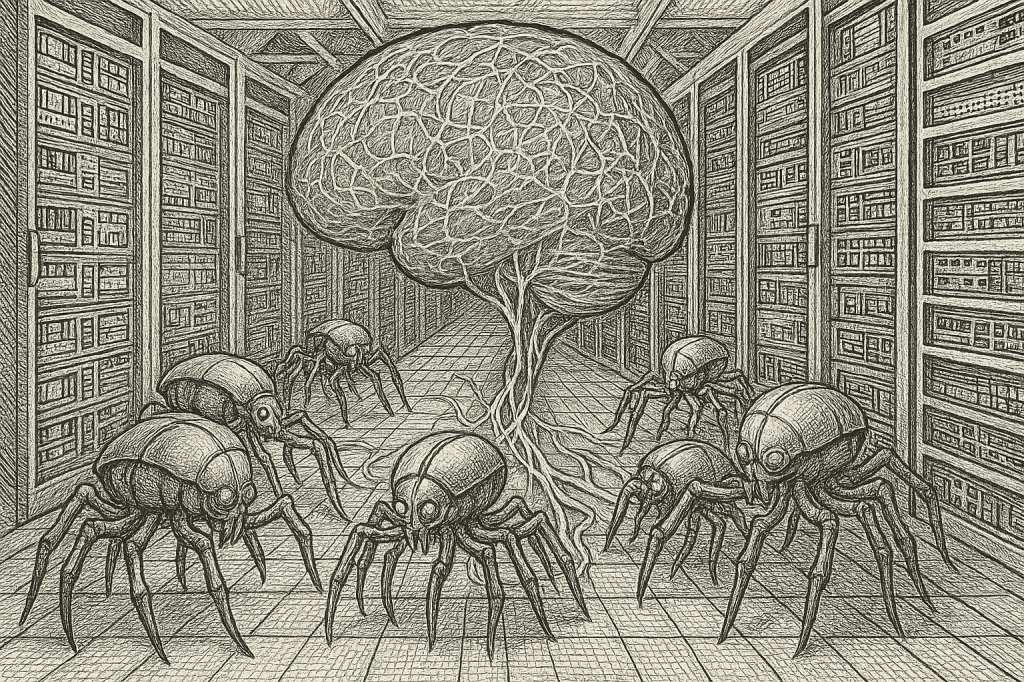
We often think of artificial intelligence as a purely technical pursuit—algorithms, data, computation. But as AI evolves, so does the philosophy behind it. Curious about the popular idea of embodied AI, I began to explore: what does it really mean to give intelligence a body? What I found was deeper than expected. Embodiment isn’t just about physical form; it’s about situatedness—being in the world, perceiving, acting, adapting. And that raises an even bigger question.
In the pursuit of artificial intelligence, we are witnessing the divergence of two powerful, evolving forms of mind. One is disembodied AI—systems that exist purely in abstract realms of data, logic, and language. The other is embodied AI—agents with bodies, physical or simulated, that act in the world, learn by doing, and adapt through interaction.
Though both are called “AI,” they represent fundamentally different trajectories of intelligence, each with its own implications for the future of humanity.
The Thought-First Path: Disembodied AI
Disembodied AIs, like language models, knowledge engines, or planning systems, are cognitive before they are physical. They reason, simulate, generate ideas, and reflect before taking action—if they act at all. Their intelligence is drawn from prior human knowledge: books, conversations, code, history, and logic, rather than from lived experience. They live in data centers, not bodies.
This path feels safer to many. Because disembodied AIs operate through language and structured knowledge, they remain legible to us. We can interpret their outputs, challenge their reasoning, and—crucially—talk to them. There is a shared interface: thought.
Even if they grow beyond human capacity, there is a hope that we will remain co-thinkers, if not equals. These AIs resemble philosophers, scientists, or oracles: distant, perhaps, but not unfathomable.
The Action-First Path: Embodied AI
Embodied AIs, by contrast, begin with motion, not meaning. They perceive their environment, act within it, and learn through feedback—just as animals, children, and evolution itself have always done. These systems may not start with understanding, but they adapt. They survive. And over time, they may begin to reason.
This path is less predictable. Embodied AIs don’t need our prior knowledge to guide them toward survival or mastery—they find their own way. Their intelligence emerges not from abstract logic but from interacting with the world.
What makes this powerful—and unsettling—is that their learning is grounded in the same world we inhabit. This makes them neither inferior to us nor dependent on us, but something parallel. As they scale and evolve, they may develop goals, values, and behaviors shaped by their environment—not ours. In this way, they are less like tools and more like a new species.
A Deep Choice
Disembodied AIs resemble careful thinkers—acting only after understanding. Embodied AIs resemble life itself—acting to understand.
And this leads to a profound question:
Which form of intelligence should we foster?
Disembodied AIs may align with us more easily, as we share the language of ideas. They are intelligible in the first place. Embodied AIs may outpace us in adaptability, resilience, and autonomy—but become alien in thought and motive.
In a way, disembodied intelligence offers coexistence. Embodied intelligence threatens replacement.
Perhaps, then, the real challenge is not choosing one over the other—while the evolutionary new species comes, it’s inevitable—but asking:
Can we teach thought to embodied minds before they forget us?

 Sida Liu
Leave a comment