
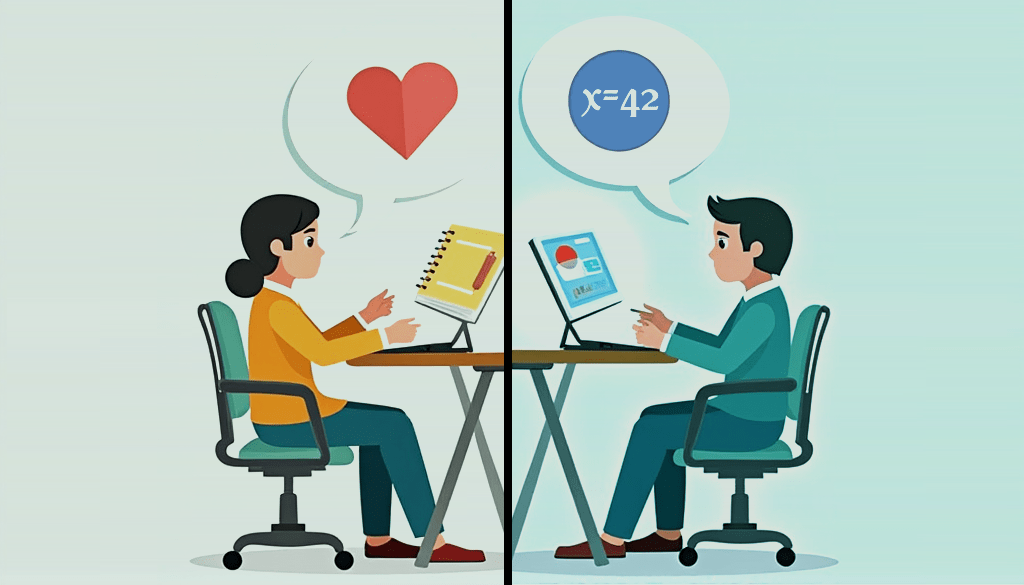
As someone new to philosophy, I was struck by the dichotomy within modern philosophy: continental and analytic. This divide felt analogous to another familiar division: that between humanities and STEM (science, technology, engineering, and mathematics) education. As the parent of a school-age kid, this resemblance intrigued me, leading me to ponder whether it was coincidental or if there might be an underlying relationship between the two.
To explore this relationship further, I did a quick search and discovered something interesting: the professional background of philosophers often correlates with their philosophical preference. Philosophers who are also scientists tend to prefer analytic philosophy, while those who are also novelists often align with continental philosophy.
This led me to question whether philosophy might shape educational systems or vice versa. But as I reflected further, I realized a third layer of comparison: the concepts of System 1 and System 2 thinking from neuroscience. Although recent research shows that these systems are not entirely distinct, the general principles of how they function offer interesting insights into the dichotomies we see in both education and philosophy.
The concepts of System 1 and System 2, popularized by the Nobel laureate Daniel Kahneman, provide a useful framework for understanding brain function.
- System 1 thinking is fast, automatic, and intuitive, often involving specialized brain areas, such as the visual cortex, to process information.
- System 2 thinking, by contrast, is slow, deliberate, and effortful. It requires the coordination of multiple brain areas, engaging more complex cognitive processes.
These two modes of thinking offer a potential analogy for understanding the differences we observe in education and philosophy.
In education, the divide between humanities and STEM reflects two distinct ways for understanding and interacting with the world:
- Humanities emphasize emotional sensitivity, perception, and the nuanced interpretation of texts and human experiences. This aligns with System 1 thinking, as these fields require intuitive, associative, and contextual understanding.
- STEM values explicit reasoning, precision, and analytical skills, closely aligned with System 2 thinking, where problem-solving demands logical processing and attention to detail.
Thus, we might see humanities as embodying System 1-style thinking and STEM as embodying System 2-style thinking.
Similarly, in philosophy, the division between continental and analytic philosophy reflects differences in approach:
- Continental philosophy emphasizes subjective experience, human perception, and the intricacies of human existence, aligning with System 1 thinking. It values emotional depth and intuitive insights over strict logical structures.
- Analytic philosophy prioritizes clarity, formal logic, and objective analysis. Its focus on explicit reasoning reflects the characteristics of System 2 thinking, favoring objectivity and precision.
This comparison reinforces the notion that these philosohpical traditions, like educational disciplines, might correspond to distinct modes of cognition:
- System 1 ≈ Humanities ≈ Continental Philosophy
- System 2 ≈ STEM ≈ Analytic Philosophy
This analogy reveals more than just parallel structures—it also highlights the importance of balance. Just as System 1 and System 2 complement each other, combining intuition with deliberate reasoning, the same synergy is essential in education and philosophy. Humanities and STEM, as well as continental and analytic approaches, each offer unique insights and methods. The most fruitful outcomes emerge when we integrate these perspectives, fostering both emotional depth and analytical rigor.

 Sida Liu
Leave a comment