
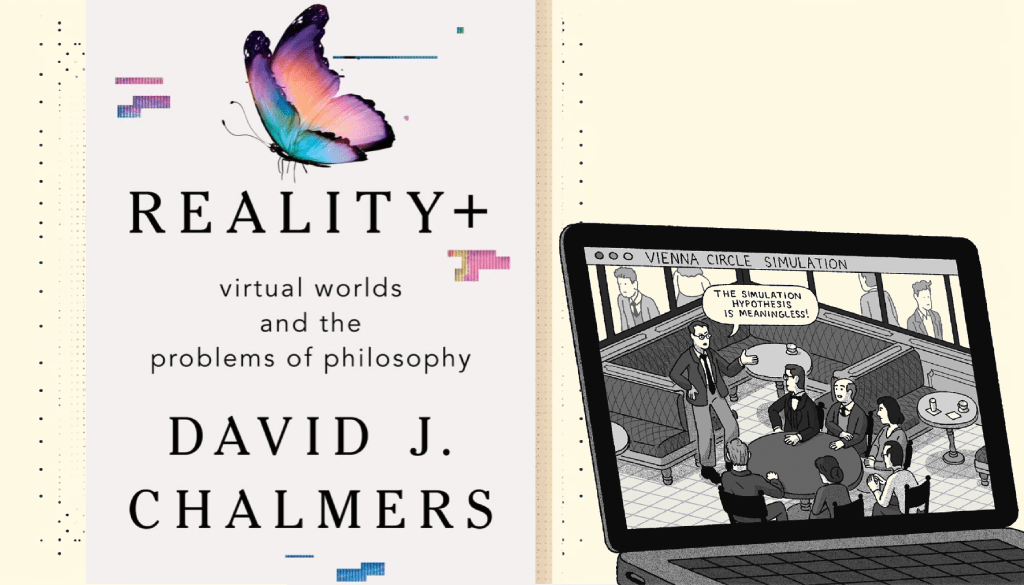
Introduction:
When we think of philosophy, we might picture ancient philosophers disconnected from modern science. However, philosophy is the reconciliation of existing knowledge, and modern science and technology have brought us enormous amount of new knowledge, it’s now philosophers’ job to digest them. This is what the author, David Chalmers, calls ‘technophilosophy’: generating new questions and using new knowledge to answer the old questions.
In this new area, Chalmers suggests that many sci-fi writers have dived as deeply as philosophers have, emphasizing the importance of sci-fi works.
Chalmers points out his main idea of this book is to argue that virtual reality is genuine reality.
Part 1: Virtual Worlds
Chapter 1: Is this the real life?
This chapter begins with ancient philosophers contemplating this question. Chalmers draws on examples from different cultures: Chinese philosopher Zhuangzi, Greek philospher Plato, and the story of the Indian deity Vishnu–all of which explore deep speculations about whether we are experiencing reality or illusions.
Next, Chalmers introduces some basic philosophical concepts, preparing beginners for the later content of the book. The book mainly focuses on three traditional philosophical questions (the old questions):
- The Knowledge Question: How do we know? (Epistemology)
- The Reality Question: What is real? (Metaphysics)
- The Value Question: What is good or bad? (Moral philosophy)
Chalmers also highlights that, throughout history, philosophy has acted as an incubator for other disciplines like physics, psychology, modern logic, and so on, leaving itself today with only very hard questions. (He might even hint that solving consciousness might require a new field beyond current science. I think he is open to this possibility.)
Chapter 2: What is the simulation hypothesis?
This chapter begins by introducing what a simulation is, and then Chalmers presents the main hypothesis of the book:
- “We are living in a computer simulation.” or more specifically, “We are and always have been in an artificially designed computer simulation of a world.”
Chalmers expresses his love for science fictions, thought experiments, and simulations, treating them as valuable tools for philosophical analysis. Interestingly, the simulation hypothesis idea came from his movie review “The Matrix as Metaphysics”, based on my favorite movie, The Matrix (1999).
Chalmers divides simulations in several different ways:
- By Type of Simulated Beings:
- Impure Simulation: Contains only biological beings connected to the simulation (biosims), like Neo and Trinity in the movie.
- Pure Simulation: Contains contains only purely simulated beings (pure sims), like Agent Smith and Oracle in the movie.
- Mixed Simulation: Contains both biosims and pure sims.
- By Scope:
- Global Simulation: Simulates everything in the world.
- Local Simulation: Only simulates part of the world to save on computation, possibly expanding dynamically as needed.
- By Duration:
- Temporary Simulation: People enter the simulation for a brief period;
- Permanent Simulation: People spend their whole lives in the simulation.
- By Fidelity:
- Perfect Simulation: Faithfully follows physical laws;
- Imperfect Simulation: Uses approximations or shortcuts to save on computation.
These distinctions are crucial, in my opinion, and Chalmers later discusses various issues with these distinctions in mind. However, I believe he should treat them more distinctly rather than generalizing the simulation hypothesis too much. The specific kind of simulation we might be living in leads to vastly different philosophical conclusions.
Chalmers also emphasizes that simulation hypothesis is not yet a scientific hypothesis. It remains a philosophical idea because it is still too vague to be tested scientifically.
Part 2: Knowledge
Chapter 3: Do we know things?
This chapter explores a fundamental question: how do we know that we know anything at all? Skepticism challenges our ability to truly know things. More specifically, Cartesian skepticism, proposed by Rene Descartes, questions whether we can know anything about the external world and reality itself.
Descartes presents three arguments for his skepticism:
- Our senses might deceive us, which resonates strongly with modern VR technology.
- We might be dreaming.
- There could be an all-powerful evil demon manipulating our perceptions and thoughts.
Chalmers imagines that this evil demon could use a simulation to deceive us, similar to what happens in The Matrix. The evil demon can be thought of as the simulator, with the power to manipulate our perceptions and thoughts in the simulation. This transforms Cartesian skepticism into a simulation-based version, which proceeds as follow:
- (Premise 1) We can’t know if we’re in a simulation.
- (Premise 2) If we’re in a simulation, then nothing is real.
- (Conclusion) Therefore, we can’t know that anything is real.
After breaking down our belief that we know the external world, Descartes seeks to establish a new foundation for knowledge, which is captured by his famous statement, “I think, therefore I am.” But this book will give a very different response.
In this chapter, Chalmers also introduces the concept of a formal philosophical argument for beginners. As we see in the simulation-based version of Cartesian skepticism, a formal argument typically starts with several premises, uses logical reasoning, and leads to a conclusion. Philosophers often craft arguments with simple and seemly true premises that, through seemly valid reasoning, arrive at some paradoxical or counterintuitive conclusions–this is what makes a formal philosophical argument interesting.
Chapter 4: Can we prove there is an external world?
Chalmers begins this chapter by illustrating how challenging it is to refute skepticism. By adopting an attitude similar to “That’s what you say,” skeptics can always reject critiques.
Descartes himself attempts to bridge the gap between the mind and the external world by invoking God. He argues that because God is perfect, God wouldn’t allow us to be deceived. Of course, Chalmers doesn’t agree with this argument–simulators, which Chalmers likens to Descartes’ God, do not need to be perfect.
Next, Chalmers discusses Idealism, a philosophical view that asserts everything is mind, and there is no external world. In this view, ‘the appearance is reality.’ He lists several objections to idealism but notes that he will later absorb some form of idealism into his interpretation.
Chalmers then defends the simulation hypothesis, arguing that, even though it is not yet a testable scientific hypothesis, it remains philosophically valuable. He also points out that the hypothesis is not contradictory, and can’t be dismissed by the simplicity argument (Ockham’s razor), and can’t be ignored in the manner of Moore’s reply, which simply insists that the external world is obvious.
Chapter 5: Is it likely that we’re in a simulation?
In this chapter, Chalmers introduces the simulation argument, suggesting that there would be far more simulations than non-simulated reality, therefore, it’s highly probable that we are in a simulation. Chalmers carefully examines the premises of the argument and discusses several objections, providing a model of how philosophers explore an argument. Rather than jumping to the conclusion or show strong preferences, he examines all aspects, emphasizing the nuances involved. It’s not just about concluding whether the argument is sound or no–it’s about understanding the subtleties.
One objection Chalmers discusses that resonates with me deeply is the existential risk. If all intelligent civilizations inevitably destroy themselves before they can produce a large number of simulations, then there wouldn’t be that many simulations as stated in the premise. Looking at our own history, it seems apparent that as our technological capbilities grow, so too does our capcity for self-destruction–eventually, a minor mistake by a small group could potentially wipe out our entire species.
My own objection is that, when reasoning along this line of thought, I arrive at something quite peculiar. Chalmers argues that people might create many simulations, but I think that the majority of those simulations would be mostly temporary and local, since permanent and global simulations are far more expensive to run. If we estimate the probability based on this, it would suggest that we’re more likely to be in a temporary and local simulation.
While exploring these arguments, Chalmers considers both pure and impure simulations. In my opinion, this makes the argument somewhat chaotic–some points apply to pure simulation but not to impure ones, and vice versa. Since our world is likely to be a pure, global, permanent, and perfect simulation, I wish Chalmers could focus more specifically on this category and clearly distinguish it to other types of simulation, such as those created by VR technologies.
Part 3: Reality
Chapter 6: What is reality?
In this chapter, Chalmers makes the important claim: virtual reality is genuine reality. He then explores the definition of reality by presenting five complementary ways to understand it:
- Reality as Existence. Something is real if it exists. For example, Santa Claus is not real because that person doesn’t exist. However, the story of Santa Claus is perfectly real.
- Reality as Causal Power. If something can cause effects, such as influencing our perception or behaviors, then it is real. In this sense, the story of Santa Claus is real because it has significant causal power, while the person is not real.
- Reality as Mind-Independence. Something is real if it continues to exist independently of whether people believe in it. For example, unlike Santa Claus, if people stopped believing in Joe Biden, he would still be out there.
- Reality as Non-Illusoriness. Things are real when they’re roughly as we believe them to be. (I found this definition less convincing, since I can’t see how this can be applied to the case of Santa Claus.)
- Reality as Genuineness. Instead of asking whether something is real, we should ask whether something is a real X. For instance, Santa Clasuse is not a real person but he is a real character in a story.
Chalmers uses these five ways to argue his claim that virtual (or simulated) reality is indeed genuine reality. He suggests that we treat the simulation hypothesis as a form of metaphysics and introduces the “it-from-bit” hypothesis from the field of physics–the idea that at the fundamental level, reality consists of information. Roughly speaking, molecules are made of atoms, atoms are made of quarks, and quarks are made of bits. I’ve heard similar views from prominent scientists, and I mostly believe this could be true. Thanks to Chalmers, now I have the term to communicate this idea.
In this chapter, Chalmers also briefly mentions other ways of defining reality, including Reality as Intersubjectivity. This definition quite resonates with my own perspective, since I have often thought of “reality as consensus”–something is real if a group of people agrees that it is real, with its “realness” increasing as more people agree. For me, realness is on a continuum.
Another interesting mention is the Chinese philosopher Philip Zhai (翟振明). As a Chinese reader, I’m glad to see a contemporary Chinese philosopher recognized beyond ancient figures like Laozi, Zhuangzi, etc. Zhai extends Berkeley’s idealism of “appreance is reality”, claiming that stable and coherent appearance is reality.
Chapter 7: Is god a hacker in the next universe up?
In this chapter, Chalmers explores the idea of god across different cultures, drawing an analogy between God and a simulator who runs the simulation. He also entertains the possibility that the simulator might be an AI or could be running a huge batch of simulations simultaneously. This perspective is compatible with creationism, which claims that our universe was created by God, as well as with naturalism, which suggests that God is just a simulator (a natural being) in the next universe up.
With this perspective in mind, Chalmers reexamines theology, speculating on who God might be and what God might do. He argues that there’s no need to warship God, as we are probably not even noticed by that being. While Chalmers discusses the concept of God, he views the other details in many religions as largely irrelevant, except the creation story.
During the discussion, Chalmers again refers the movie The Matrix, which depicts an impure simulation. However, when discussing our own world, we are likely dealing with a pure simulation, which is fundamentally different. I believe this confusion stems from the attempt to generalize the simulation hypothesis across both pure and impure simulation.
Chapter 8: Is the universe made of information?
In this chapter, Chalmers returns to his suggestion of treating the simulation hypothesis as metaphysics, focusing in more detail on the “it-from-bit” hypothesis–the idea that reality is made of information.
To start, Chalmers mentions Yin and Yang in I Ching, the work of Leibniz on binary arithmetic, and Conway’s Game of Life, demonstrating how bits can give rise to systems. He then introduces the history of metaphysics from ancient water-based and fire-based theories to others, noting that, in Western philosophy since the time of Descartes, metaphysical theories have generally fallen into three categories: materialism, dualism, or idealism. Thus, he finds it exciting to treat “it-from-bit” hypothesis as a new metaphysical theory, viewing reality as being made of information.
To clarify the concept of information, Chalmers explores different definitions and highlights Structural Information as the most relevant. Structural information involves a sequence or structure of bits and is central in modern computer technology. Facts can be encoded by this structural information. While we can understand the structural information in terms of “bits”, Chalmers points out that that when quantum computers are used, the term becomes “qubits”; or when analog computers are used, the term could be “reals”. The book uses “bits” but the underlying idea generalizes to “qubits” and “reals” as well.
Chalmers argues that the most important aspect of structural information is its structure, not the substrate (its underlying substance). He explains the “it-from-bit” thesis as follow: every “it”—every physical object and quantity—is grounded in a pattern of bits. Physical quantities such as mass or charge, and potentially even space and time, emerge from interactions of these bits.
However, Chalmers likens perfect “it-from-bit” hypothesis to the perfect simulation hypothesis in the way that both are unlikely to be falsified. Therefore, “it-from-bit” hypothesis remains within the realm of philosophy rather than gaining popularity in physics.
Chalmers also explores what might underlie the “bit” itself. One possibility is “it-from-bit-from-it”, which suggests information is realized by something physical, like a computer. Alternatively, there could be pure “it-from-bit”, which treats information as fundamental.
Chapter 9: Did simulation create its from bits?
In this chapter, Chalmers seriously applies “it-from-bit” hypothesis to creationism, suggesting that, for those of us inside the simulation, the simulator takes on the role of God. He argues that if God were to reveal themselves and show us how our world was created using “it-from-bit,” we wouldn’t conclude that nothing in our world is real, that is, things in the simulation are real. This leads Chalmers to conclude with simulation realism: If we’re in a simulation, most of our ordinary beliefs in reality are still true.
There are potential objections to this conclusion, and Chalmers addresses each of them, including the famous “A simulated hurricane doesn’t make you wet” argument. Chalmers contends that for the beings who always live within the simulation and experience it as their world, a simulated hurricane in that simulation is just perfectly real to them and will make them wet.
This conclusion directly challenges and falsifies the second premise of the simulation-based version of Cartesian skepticism, which states that “In a simulation, nothing is real.” By doing this, Chalmers effectively completes his argument against Cartesian skepticism, demonstrating that, in a simulation, reality can exist.
Part 4 Real Virtual Reality
Part 4 contains Chapter 10-13 and focuses on current-day VR technology and impure, local, temporary simulations. I’ll skip summarizing this part, as I’m more interested in our world, which is potentially a pure, global, permanent simulation.
Part 5: Mind
Part 5 contains Chapter 14-16 and is about mind and consciousness. Chapter 14 illustrates the connection between dualism and impure simulations, but ends with the judgement that we are probably in a pure simulation. Chapter 15 discusses the consciousness of simulated beings. Chapter 16 argues that technology extends the mind. Consciousness is one of Chalmers’ most recognized areas of expertise, but since it remains a hard problem, I’ll leave the discussion of consciousness for another time.
Part 6: Value
Part 6 contains chapter 17-19 and is about value, moral and ethics. Chapter 17 mainly discusses ethics within VR technology (which is about impure simulations). Chapter 18 discusses the moral status of simulated beings–should they be treated with the same consideration as their physical counterparts? Chapter 19 looks at justic and governance in impure simulations.
Part 7: Foundations
This part dives deeper into the philosophical foundations of the argument for simulation realism and focuses on pure simulations. Since it aligns more closely with my interests, I will continue summarizing each chapter in this part.
Chapter 20: What do our words mean in virtual worlds?
Language is an important tool for philosophy, but it is also a malleable instrument that bends to our purposes. Language was invented for communication, and it is often imprecise, with meaning that vary across different contexts. Philosophers throughout history have struggled with the versatility of the language, and some have worked hard to make it more precise, formal and reliable, leading to the creation of tools like dictionary and modern logic.
Chalmers argues that beings inside a simulation will use language differently compared to beings outside the simulation. For instance, when beings inside the simulation say “hurricane”, they mean the digital hurricane within their simulation. Similarly, when they say “reality”, they mean their environment, which is the simulation itself.
Chapter 21: Do dust clouds run computer programs?
This chapter is a serious discussion of the dust theory from Greg Egan’s novel Permutation City (1994). I’m glad to see this because my friend Lapo had just recommended the novel to me a month ago, and I greatly enjoyed it.
The dust theory boldly abandons the notion of causal relationships, proposing that, outside space and time, a large cloud of dust randomly fluctuates with no cause and effect. According to probability, the dust could coincidentally give rise to the state of one moment of our entire universe, and somewhere else, the state of the next moment. Thus, everything we experience might be just a series of disconnected states–a collection of snapshots. Even if each snapshot disappears and reappears elsewhere, we would still experience continuity from one moment to the next. In this view, reality is simply made up of these states arising from random fluctuations of the dust.
In philosophy, critiquing an idea often indicates that you love it, because you treat it seriously. Chalmers asks a challenging question regarding the experiments that led to the dust theory. In the simulation experiments described in the novel, which use randomly allocated computational power and shuffled time sequences, the simulator must somehow distribute the information out and recollect the information back to make the being in the simulation experience the continuity of the environment. Therefore, these experiments can’t serve as evidence for the dust theory; they merely inspired the protagonist to conceive of it.
More importantly, Chalmers argues that cause and effect can’t be eliminated when discussing the execution of an algorithm. To Chalmers, a simulation is fundamentally a system of complex patterns of cause and effect. If the dust theory disregards cause and effect, in his view, there can be no simulation to begin with.
My own objection to the dust theory, similar to Chalmers’ belief in the importance of cause and effect, is that if our reality were just one state of the random fluctuations after another, why would our experiences be so consistent? Statistically, it seems far more likely that we would experience some fragmented, disordered states with no underlying causal structure. For example, the force we experience at this moment is equally likely to act in any directions, statistically speaking, given all other conditions the same. This inconsistency contradicts the stable experience we have in reality.
Chalmers emphasizes that we should respect cause and effect and acknowledge that systems have rules beyond states. Philosophers call these causal constraints counterfactuals, meaning something could have happened if certain conditions had been met. Thus, computers, or Causation Machines as Chalmers calls them, are still needed for algorithms and systems to run.
Chapter 22: Is reality a mathematical structure?
Philosophers, starting with Rudolf Carnap, have worked on reducing everything to structures, eliminating non-structural information. There’s a ongoing debate on what successful scientific theories and models tell us. Do they give us insight into what is real, or, do they merely serve as a convenient and useful framework for predicting the future. Structural realism claims that the success of our scientific theories is explained by how well the structure they describe matches the structure that is present in the world. Concepts like “mass”, “charge”, “time”, and “space” are just names, but what really matters is the structure.
Some suggest that the universe is mathematical, such as the ancient philosopher Pythagoras and the contemporary scientist Max Tegmark. Chalmers argues that physics theories need to go beyond pure mathematical structure. He believes that existence in scientific theories must be interpreted as concrete existence, not an abstract one–it has to be connected to the physical world. I am conservative on this argument. As far as I know, Tegmark claims that at the fundamental level, there’s only mathematics, or should we say, physics and mathematics are one and the same. But at a higher level, for example when we discussing Newtonian physics, an object is made of the math underlying that concrete object. When referring to the object, it is equivalent to say that we are referring to the extensive mathematical package underneath it. I think this perspective is compatible with Chalmers’ idea that physics must connect to concrete existence.
Beyond structure, physics also cares about observation. It is interesting to see how Chalmers interprets quantum physics. The Schrodinger equation describe the structure of a particle, while the Born rule connects this structure to the probabilistic results of observation.
Later, when discussing what realizes the structure, Chalmers introduces Kantian humility and connects it to “it-from-bit-from-X” thesis, stating that we might never be able to know what underneath the “bits”. This resonates with Kantian humility in that we can only know the appearance of things and would never know things in themselves.
Chapter 23: Have we fallen from the Garden of Eden?
Chalmers discusses the difference between the manifest image–the world as it appears to ordinary perception and thought–and the scientific image–the world as described by science.
Chalmers likens the manifest image to what it might have been like in the Garden of Eden, and the scientific image to what we have after the fall from Eden.
The manifest image is absolute. Edenic Solid (Chalmers uses capitalized words for distinguishing) refers to an object that is completely rigid and without gaps. On the other hand, in the light of science, nothing is truly Edenic Solid. Instead, we can still use the concept of “solid” in a functionlistic way–a solid object is simply an object that behaves as a solid object.
Chalmers argues that if we were to complete use the scientific image, we would barely function in our everyday lives–something that makes me think of stereotypically nerdy, mad scientists who are detached from common experience. Interestingly, Galileo once claims that the apple is not really red at all. But fortunately, this view has never really caught on.
So the world is imperfect. Just as we don’t have anything that is perfectly Edenic Solid, but we only have things imperfectly solid. This concept is part of imperfect realism, which Chalmers thinks is the correct view for many important philosophical topics, such as Free Will, Right and Wrong.
Chalmers also likens the manifest image to Plato’s Forms, while the scientific image is akin to the shadows on the wall of Plato’s cave.
Chapter 24: Are we Boltzmann brains in a dream world?
In this chapter, Chalmers addresses several skeptical challenges one by one, such as local simulations, temporary simulations, imperfect simulations, preprogrammed simulations, Gods and evil demons, dreams, Boltzmann brains. Although some local skepticism can’t be completely ruled out, he argues that none of these scenarios lead to global skepticism.
To Chalmers, since we experience a world with regularities, there must be some explanation for everything we perceive and believe. These explanation indicates that there’s an external world with a certain structure that vindicates much of what we perceive and believe. In short, “explanation yields structure, and structure yields reality.”
The book ends with the assertion that there is still much we don’t know or can’t know, but the reality is out there, if we follow the regularity and the structure beneath it, we can at least know some of it.
My Epilogue
When doing philosophy, we don’t need to fully accept someone else’s theory and arguments. If even one perspective can inspire us, it is valuable. While I do not entirely agree with all the arguments and conclusions in this book, I have learned a great deal from it. It is a wonderful beginning to my journey into philosophy.

 Sida Liu
Leave a comment